
Quick answer
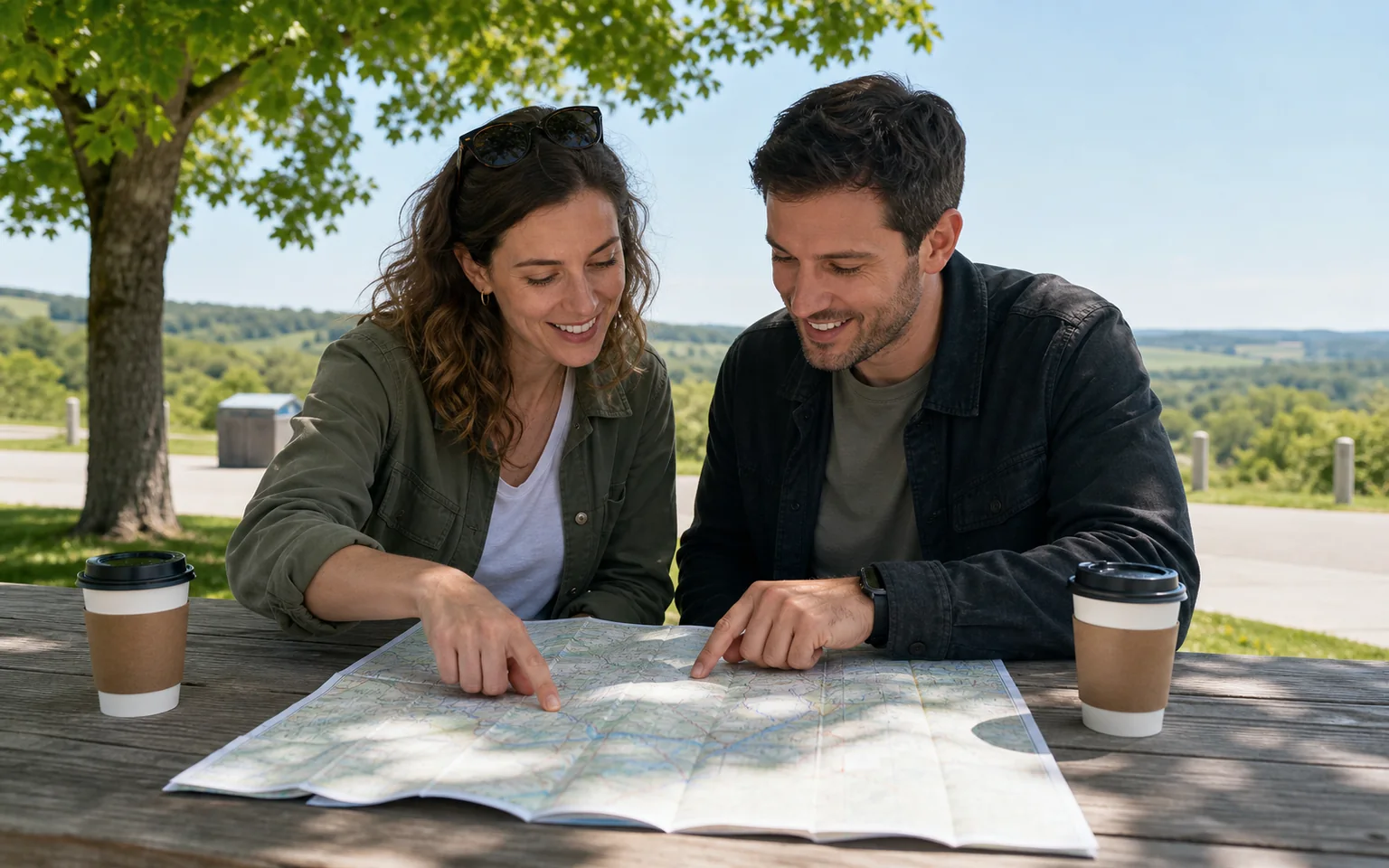
Ohio dating works best when both people discuss the practical radius before building a plan. Compare the drive on an ordinary weeknight, not only the mileage. Then choose a public venue near a clear route, keep the first meeting time-limited, and name a weather backup. People in smaller communities may prefer a nearby town for privacy; people in larger metros may prefer a neighborhood neither person treats as home turf.
Start with a human radius
Most dating filters treat distance as a circle. Ohio life rarely does. A 45-mile trip along a familiar interstate can feel easier than 18 miles across rush-hour construction. The same route may feel completely different after dark in January. Work schedules, custody arrangements, mobility needs, and comfort with winter driving also change what “nearby” means.
Before either person suggests a venue, ask a question that invites a real answer: “What kind of drive feels normal for a first date?” Follow with a day and time. Someone may welcome a Saturday afternoon in another region while declining the same route after work.
For a connection that will involve repeated trips, use the long-distance HSV dating guide for Ohio to compare both people's monthly travel, meeting frequency and share of the planning work.
Good distance planning is not romantic arithmetic. It is a small test of whether two people can make a fair plan together.
| Planning factor | Useful question | What to avoid |
|---|---|---|
| Travel | Which route do you already know well? | Assuming equal mileage means equal effort |
| Timing | Would daytime or early evening feel easier? | A late plan with a long drive home |
| Privacy | Would a nearby town feel more comfortable? | Choosing someone’s regular workplace or hangout |
| Access | Do we need step-free entry, seating, or close parking? | Leaving access questions until arrival |
| Weather | What is our indoor backup? | Treating a forecast as a promise |
Five Ohio dating rhythms
Lake Erie and Northeast Ohio
Cleveland, Akron, Lorain, and surrounding communities offer many public meeting choices, but lake-effect weather can alter a simple route quickly. Pick a venue that does not require a long outdoor walk in winter and decide how you will confirm or reschedule. A museum café, market, bookstore area, or casual counter-service spot can provide a clear meeting point without making the date feel formal.
Northeast Ohio also has distinct neighborhood identities. Clarify the actual side of town instead of assuming “Cleveland area” means a short trip. If privacy matters, select a busy public location outside both people’s routine neighborhoods.
Central Ohio
Columbus can be a workable midpoint for people coming from several directions. Yet an event, a game, construction, or rush-hour traffic can change an otherwise simple plan. Name the neighborhood, parking arrangement, and entrance. “Meet downtown” leaves too many details unresolved for a first meeting.
Central Ohio makes a good case for a two-stage date. Begin with a one-hour coffee or lunch. If conversation is easy and both people want more time, add a public walk, gallery, or second stop nearby. Nobody has to commit to a full evening before meeting.
Southwest Ohio and the I-75 corridor
Cincinnati and Dayton connections can involve interstate travel, river crossings, and people whose daily lives extend into Kentucky or Indiana. Ask where the person is actually starting from that day. A venue that looks central on a map may not be central to two commutes.
For a tri-state connection, avoid making one person cross every boundary by default. Alternating regions later can be fair. For the first meeting, ease and familiarity matter more than perfectly dividing the distance.
Northwest Ohio
Toledo-area dating can include Michigan connections and a wider radius across smaller communities. Confirm the state and time zone details if a plan stretches farther west, and do not treat “just over the line” as a tiny trip without checking the route. Daytime plans are useful when both people are still learning whether the distance is sustainable.
Smaller cities, college towns, and rural counties
In a community where coworkers, relatives, and friends often know the same places, privacy can influence venue choice. Privacy is not the same as secrecy. A person may simply want time to understand a new connection before making it visible to an overlapping social circle.
Consider a busier venue in the next town, a daytime regional attraction, or a public location with several activities nearby. Keep the travel burden proportionate. A connection should not require one person to reveal their exact address or drive to an unfamiliar remote area.
Build a four-season plan
Ohio weather is part of date design. Summer heat can make a long outdoor walk tiring. Spring storms can turn a park plan into a scramble. Autumn event traffic can complicate parking. Winter brings cold, darkness, and rapidly changing road conditions.
Use a simple A/B plan. Plan A is the date you hope to have. Plan B is nearby, indoors, and easy to name in one message. A good backup is not “we will figure something out.” It is “If the weather changes, let’s meet inside the main library entrance instead.”
- Confirm the plan on the day without demanding continuous location updates.
- Use an official weather source and local road information for travel decisions.
- Do not pressure someone to drive when they are uncomfortable with conditions.
- Carry enough charge and fuel for the return trip.
- Rescheduling is a practical choice, not evidence of low interest.
Make public feel comfortable
A public place offers other people, staff, lighting, and a clear exit. It does not need to be crowded or loud. Look for a venue where conversation is possible, each person can buy their own item, and staying for 45 to 90 minutes feels normal.
Avoid first meetings at either person’s home, a remote trail, an isolated parking area, or a place where one person controls transportation. Arrive independently. Tell a trusted person where you will be and when you expect to check in. The dating safety guide covers the full check-in plan.
Keep health information in the right lane
Having HSV in common does not make health conversations automatic or identical. People may have different HSV types, symptom histories, testing information, treatment plans, and boundaries. Talk about sexual health before sexual contact and use a healthcare professional for individual medical decisions.
The CDC genital herpes overview explains that herpes can spread without a visible sore, condoms can reduce but do not eliminate risk, and daily suppressive medicine can lower transmission risk in some situations. The Ohio Department of Health directory can help readers locate a local health district; confirm available services directly with the location.
A ten-minute planning script
- Share a broad starting area, not a home address.
- Compare the drive at the actual meeting time.
- Pick a busy public venue with a clear entrance.
- Set a short first plan and an optional extension.
- Confirm access, budget, and food or sensory needs.
- Name an indoor or weather-safe alternative.
- Arrive and leave independently.
- Tell a trusted person the public plan.
The goal is not to remove every unknown. It is to handle the predictable parts well enough that both people can pay attention to the conversation.